Persecution Memory and Victim Identity
Under the Banner of HeavenPersecution Memory and Victim Identity is the process by which remembered attacks and forced departures become part of a group’s shared account of itself. In the book, persecution is not only a record of harm inflicted on Mormons: it becomes a test of faith, evidence of chosenness, and a resource for holding the community together. The same memory can also sharpen the division between insiders and outsiders, making past suffering available to leaders as a means of mobilizing present-day fear and resistance.
Suffering as a mark of belonging
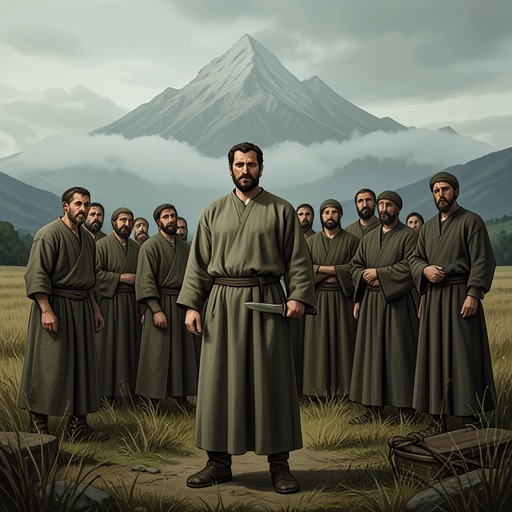
The book presents persecution as an early and formative feature of Mormon collective identity. By the end of the community’s stay in Missouri, its members had accumulated a history of trials that could be remembered and commemorated. Suffering became a distinctive badge of membership and a test of faith: enduring opposition could be understood as evidence that the Saints were chosen. In this account, hardship did not simply threaten the young church; it helped define who belonged to it.
The narration also emphasizes the organizing force of that memory. Opposition could give struggle meaning and strengthen a community’s confidence in itself. The memory of persecution helped bind members together, and the book suggests that without suffering—and without the encouragement and recollection of it—the early church might not have prospered in the same way. The result is a paradoxical inheritance: injury and displacement remain losses, while recollection of them also provides a shared story through which the group can endure.
Expulsion, violence, and collective memory
In Jackson County, Missouri, conflict grew amid the arrival of Mormon settlers who believed the region was their divinely appointed Zion. Their claims to be God’s chosen people and to have a divine right to the land heightened the antagonism of local residents. In 1833, an armed mob attacked members of the community, destroyed a printing office, and forced Mormon leaders to promise that they would leave the county. Later that year, violence against Mormon settlements drove about twelve hundred Saints from their homes into the cold darkness. These events made displacement a defining part of the community’s remembered past.
The Haun’s Mill Massacre added another lasting wound to that history. Eighteen Saints were killed in and around the settlement’s blacksmith shop. The massacre entered Latter-day Saint collective memory and remained a source of indignation more than 160 years later. Its significance in the narrative is not confined to the violence itself: the memory of the killings and of the community’s repeated vulnerability became part of a wider account of what the Saints had suffered and why they must not be driven out again.
The book follows this memory into the Mormon exodus. The people left in bitterness and in hope, while successive wagon trains were understood through the biblical pattern of flight from Egypt. The comparison turned migration into more than a practical response to danger. It offered a religious and communal frame for departure, giving the scattered group a sense of shared history and purpose. In this telling, movement across the landscape repeatedly reenacted an earlier flight, and collective identity traveled with the people who carried the story.
From remembered injury to mobilization
The narrative shows how recollection of past persecution could be used to shape a response to new threats. While the Saints awaited the federal army in 1857, Brigham Young and other church leaders reminded them of the murders in Missouri and Illinois and of Joseph Smith’s death at the hands of a mob in Hancock County. Rumors that the approaching troops intended to hang Brigham and exterminate the Mormons further intensified alarm. Across Utah Territory, people retold and relived the mobbings, burnings, and expulsion from Nauvoo.
That rehearsal of suffering had consequences in the present. By August, hostility toward Gentiles had risen sharply; militias drilled across Utah Territory, and Saints were instructed not to supply provisions to Gentile wagon trains. Leaders also raised the prospect of destroying towns and crops rather than allowing an invading army to take them. The Fancher company entered this atmosphere when it crossed the Wasatch Range and descended Emigration Canyon into the Great Salt Lake Valley on August 3, 1857. The book places the emigrants’ arrival against a landscape of fear in which old injuries were being recalled as grounds for readiness to fight.
After the Mountain Meadows Massacre, the same mechanism of collective defense took a darker form. According to John D. Lee’s account, those gathered at the site gave thanks to God for the defeat of their enemies, then insisted that the Indians alone were responsible and agreed that anyone who revealed the truth should suffer death. The episode shows how a community’s language of threatened identity could coexist with concealment and collective silence. Here, the memory of persecution did not merely preserve the story of past victims; it helped frame a new act of violence and the effort to hide responsibility for it.
Boundaries, apostasy, and moral division
The book connects persecution memory to a broader religious division between the faithful and those cast as enemies. The Book of Mormon presents existence as a struggle between two churches, one belonging to God and the other to the devil. In the account of Mormon settlement in Missouri, the Saints’ conviction that they were chosen and their judgment that those who knowingly rejected their religious claims were undeserving of sympathy reinforced an uncompromising boundary between insiders and outsiders. That boundary could make opposition appear not simply political or local, but part of a larger moral conflict.
In the later fundamentalist community described in the book, the boundary could also turn inward. Colorado City residents were forbidden to have contact with people outside the United Effort Plan, including relatives who had left the faith. DeLoy Bateman’s departure from the Work placed him in the category of apostate, and his brother was not allowed to speak with him. When DeLoy failed to attend a priesthood meeting, Rulon Jeffs sent someone to claim his wives and children for another man, in accordance with a doctrine that treated families as the priesthood’s property. Both wives refused to leave DeLoy, and most of the children became apostates as well. The episode demonstrates how religious authority could define loyalty and separation inside a community whose identity was already organized around the distinction between the faithful and those beyond its bounds.
The book’s accounts of Ron and Dan Lafferty provide another instance of an absolute division between the righteous and the wicked. In a court setting, Dr. Gardner argued that Ron’s revelations had been evaluated within a group of like-minded believers, while also describing symptoms of narcissistic personality disorder. Dan, in a later account of his beliefs, divided humanity into children of God and children of the devil, treating that distinction as fixed. These passages do not equate all forms of persecution memory with violence; rather, they show how sharply bounded moral categories can sustain a worldview in which disagreement and opposition are read through an already charged division between good and evil.
Significance
Persecution Memory and Victim Identity therefore names a double-edged social inheritance in the book. Recalling expulsion and violence can preserve a community’s history, explain its cohesion, and give meaning to survival and migration. But when leaders repeatedly invoke remembered injuries to define present enemies, the past can become an instrument of mobilization. The narrative follows that shift from persecution endured, to persecution commemorated, to the use of grievance in enforcing boundaries and preparing for conflict. It leaves the memory’s central tension intact: shared suffering can bind a threatened community together, while the identity built around that suffering can also harden the line between those counted as its own and those treated as enemies.